


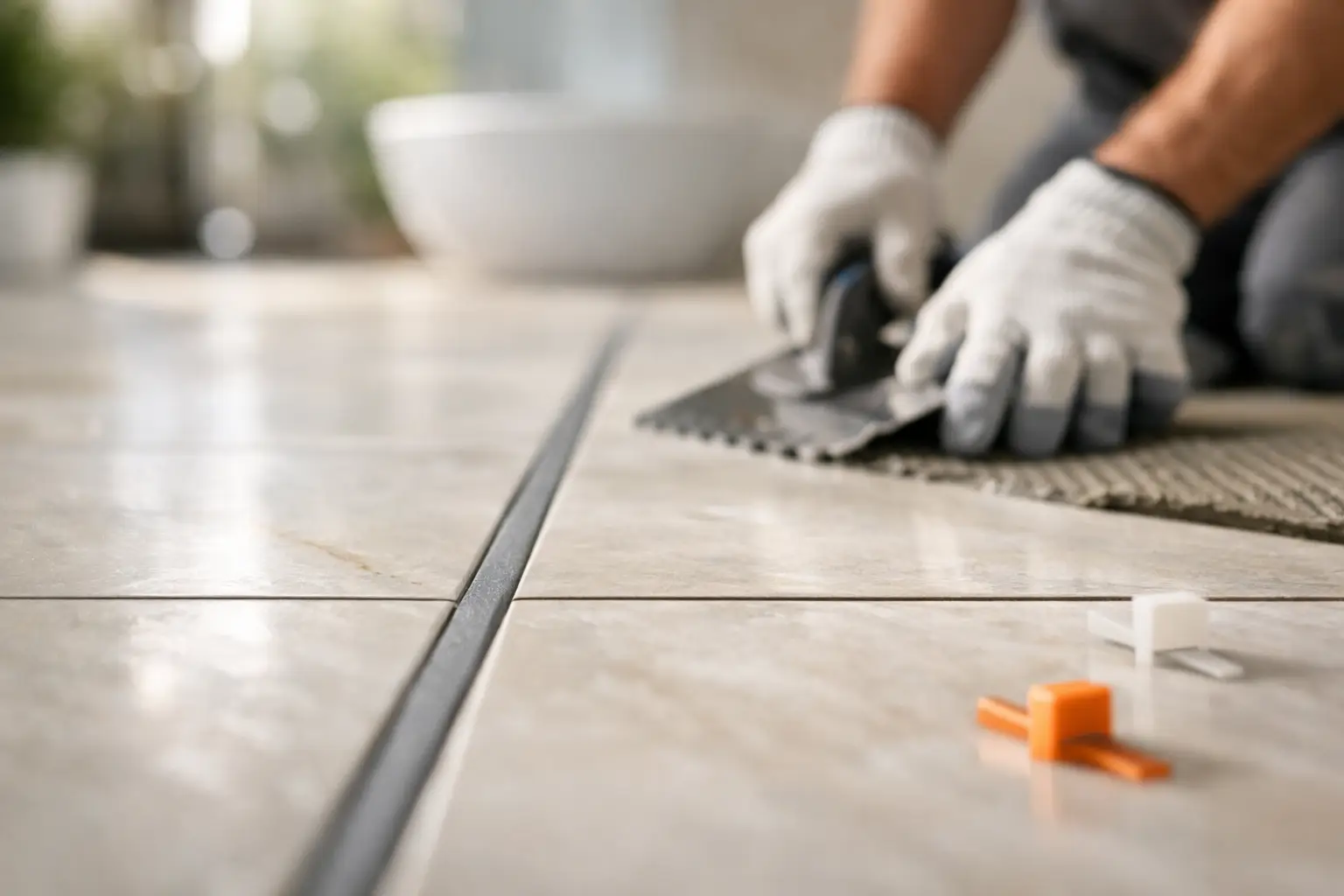
Why Movement Joints Protect Premium Tilework
A flawless tiled floor can fail long after the installer has left site. The tiles may be perfectly level, the grout colour carefully chosen and the mitred details exact, yet a restrained floor can still crack, tent or debond when the building moves. Movement joints are the deliberate breaks that prevent that pressure from being transferred through a finished tile surface.
They are not an optional cosmetic detail, nor a sign that an installation is less refined. Properly planned movement accommodation is one of the details that separates a durable tiled finish from one that simply looks impressive on handover. On premium projects, where large-format porcelain, natural stone and continuous sightlines are central to the design, the joint strategy must be considered at the same stage as tile layout, falls, waterproofing and thresholds.
What movement joints do in tiled installations
Tile, adhesive, screed, concrete, timber and steel all respond differently to heat, moisture, loading and structural movement. A sunlit glazed extension can heat up considerably during the day. Underfloor heating cycles a floor through repeated temperature changes. New screeds shrink as they cure, while suspended floors can flex under live loads. In wet rooms, pools and spa environments, moisture adds another variable.
Tiles and grout are hard finishes. They do not absorb this movement indefinitely. If the assembly is locked tightly between walls, columns, doorways or changes in substrate, stress builds until it finds a release point. That may appear as cracked grout, fractured tiles, hollow-sounding areas, lifted edges or a section of floor that tents upwards without warning.
A movement joint creates a controlled, flexible line within the finish. It allows adjacent sections to move independently while maintaining a clean, purposeful appearance. The joint is usually filled with a suitable elastic sealant or formed with a purpose-designed movement profile, chosen to suit the exposure, expected movement and visual specification.
Movement joints are not the same as grout joints
This distinction matters. A grout joint spaces tiles and finishes the gaps between them, but conventional cementitious grout is not designed to accommodate meaningful expansion or structural movement. Even a carefully selected flexible grout has limits.
Movement joints are wider, continuous and deliberately located to relieve pressure. They should pass through the tile finish and adhesive bed, rather than being cut superficially into grout after the floor has been installed. In many projects, they must also align with joints already present in the screed or structure below.
For a large marble-effect porcelain floor, for example, a designer may prefer a narrow, restrained grid with colour-matched grout. That visual objective is entirely achievable, but it cannot override the requirements of the substrate. The right approach is to place movement lines where they support the architecture: at changes in plane, beneath door positions, along perimeter transitions, between zones, or within a logical tile module where the field is extensive.
Perimeter, field and structural joints
Perimeter joints sit around the edge of a tiled area, separating the finish from walls, upstands, columns, kitchen islands and fixed joinery. They are especially important where a floor runs tightly into rigid features. Skirting or a carefully detailed sealant line can conceal or refine the joint without restricting it.
Field joints divide a large tiled area into manageable sections. Their spacing depends on the tile type and format, substrate, exposure to sunlight, heating system, room geometry and installation system. There is no responsible one-size-fits-all measurement for every floor. A shaded internal hallway on a stable substrate presents a different risk profile from a south-facing orangery with 1200mm porcelain tiles and underfloor heating.
Structural or substrate joints already exist within concrete slabs, screeds and building elements. These must be respected and continued through the finished tile surface. Bridging a structural joint with tiles may initially produce an uninterrupted finish, but it leaves the tilework to absorb building movement it was never designed to carry.
Where movement joints matter most
Every tiled surface needs an assessment, but some settings demand particular care. Large open-plan floors are a common example. The visual appeal of continuous porcelain flowing from kitchen to dining space and into a glazed garden room is obvious. It also creates a larger restrained area, often with differing temperatures across the floor. Joint locations need to be incorporated into the layout before tiles are ordered and cut.
Underfloor-heated floors deserve the same discipline. A correctly commissioned heating system, suitable flexible adhesive and an appropriate uncoupling or crack-isolation strategy all help, but they do not remove the need for movement accommodation. Heating introduces regular expansion and contraction, particularly at zones with large areas of glazing or varying floor temperatures.
Wet rooms require a coordinated approach. The movement joint must work with the waterproofing assembly, floor falls and drainage details. At wall-to-floor junctions and changes of plane, a compatible flexible sealant and waterproofing system are essential. A movement gap that is simply filled with an unsuitable product can become a route for water ingress behind tile finishes.
Balconies, terraces and exterior steps are among the most demanding environments. They face solar gain, frost, rain, standing water and significant thermal variation. Here, movement joints must be considered alongside falls, drainage channels, edge detailing and the waterproof layer. A premium external porcelain finish is only as reliable as the assembly beneath it.
Pools and spas create a different set of pressures: continuous humidity, chemical exposure, immersion zones and structural movement around tank construction. The joint sealant and profile specification must be appropriate for that environment, not merely selected for colour. This is an area where experience with specialist systems is more valuable than a generic tiling detail.
Planning the joints before installation
The best time to decide where movement joints belong is before setting out begins. By then, the contractor should understand the substrate condition, screed age and specification, floor build-up, heating zones, drainage requirements and intended tile layout. For refurbishment work, this includes identifying existing cracks, interfaces between old and new construction, and any unknown movement in a heritage structure.
A technical site survey should establish whether the floor is sound, flat and sufficiently cured, but also whether it is divided by existing control joints or changes in material. A 70mm sand and cement screed behaves differently from a proprietary rapid-drying screed. A concrete slab is different again from a timber floor strengthened for stone or porcelain. Adhesive choice, uncoupling systems and movement joint placement should follow the actual construction, not assumptions made from drawings alone.
Tile size affects the visual and practical outcome. With 3.0m x 1.5m panels, a movement line cannot be treated as an afterthought because each cut is consequential and the handling process is exacting. With smaller tiles, the joint can often be integrated more subtly into a wider layout. In either case, it should be agreed with the architect, designer and client before installation, particularly where a matching silicone, metal profile or resin finish will be visible.
How a premium finish keeps joints discreet
A movement joint does not have to interrupt the design. It can be aligned with a doorway threshold, a change between tile directions, the edge of a linear drain, a feature strip or a natural room division. On a commercial floor, profiles can be selected to manage traffic and protect tile edges. In luxury bathrooms, colour-matched sanitary sealant can provide a quiet, coordinated line at changes of plane.
There are trade-offs. A nearly invisible sealant joint may suit a calm residential interior but be less appropriate than a durable profile in a hotel entrance or retail environment. Likewise, a profile chosen purely for appearance may not have the capacity required at a demanding transition. The final detail should be led by movement requirements first, then refined to suit the interior scheme.
Atlas Tiling approaches this as part of the full installation system, not as a final sealing task. That means coordinating movement accommodation with substrate preparation, waterproofing, adhesive selection, drainage and the finish expected from high-value porcelain and natural-stone projects.
Common failures caused by poor joint detailing
The most expensive failures often begin with a decision intended to preserve an uninterrupted appearance. Filling perimeter gaps solid with grout, tiling across a screed joint, or omitting field joints from a heated floor can leave no visible warning until the stress becomes excessive.
Tenting is particularly disruptive. Tiles can lift sharply along a line, sometimes with a loud report, creating a trip hazard and damaging a large area of otherwise sound material. Repairs may require lifting surrounding tiles, reinstating the substrate and replacing pieces from a batch that may no longer be available. On a carefully matched marble-effect porcelain installation, this can compromise the whole visual composition.
Water damage is another concern. In showers, wet rooms and exterior settings, failed sealant at movement points can allow moisture behind the finish. The visible problem may be minor at first, while the waterproofing layer, adhesive bond or backing board is being put under pressure out of sight.
A movement joint is a small line in a drawing and an even smaller line in a finished room. Planned properly, it protects the investment in every tile around it while allowing the workmanship, material and architecture to remain the focus.


Comments