


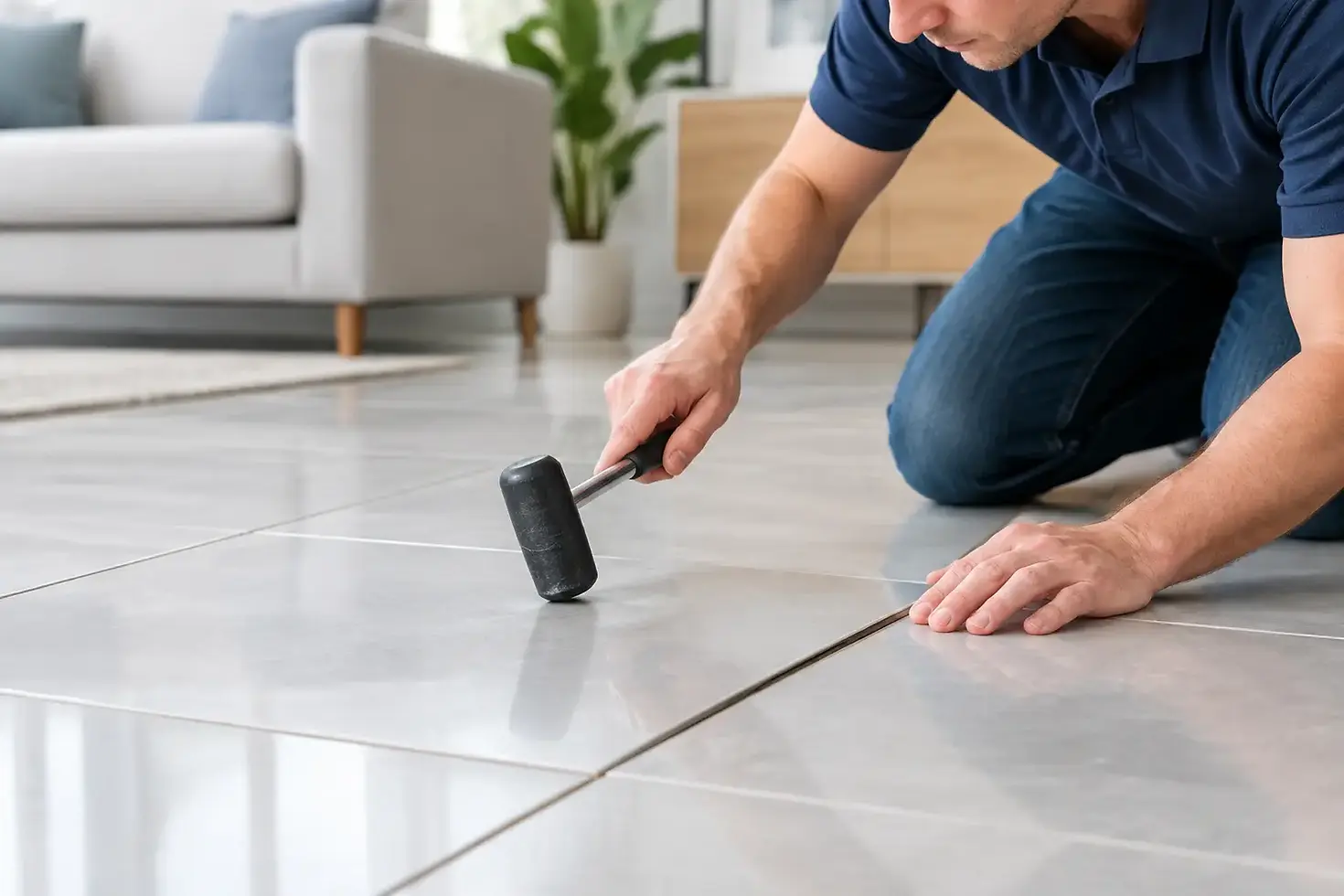
What Causes Hollow Floor Tiles? A Proper Diagnosis
A crisp porcelain floor can look immaculate yet sound distinctly different underfoot: a solid knock in one area, a hollow drumbeat in another. So, what causes hollow floor tiles? Usually, it is a void between the tile and its adhesive bed. The reason for that void, however, can range from poor installation technique to movement in the structure below. The distinction matters because a tile that sounds hollow is not automatically about to fail, but it should never be dismissed without a proper assessment.
For high-value bathrooms, entrance halls, hotel floors and wet areas, the finish is only as reliable as the preparation and fixing system beneath it. Large-format porcelain, natural stone and marble-effect tiles demand particularly exacting work. Their size, rigidity and reflective finish leave little room for inadequate adhesive coverage or an uneven substrate.
What causes hollow floor tiles in the first place?
The immediate cause is an unfilled space beneath the tile. When a tiled floor is tapped with a hard object, a well-bonded tile gives a compact, solid sound. A tile with air pockets may sound hollow because part of its underside is unsupported.
That unsupported area can develop at installation, or it can appear later as the adhesive bond breaks down. A hollow sound alone does not reveal the extent of the problem. A small isolated void within an otherwise sound adhesive bed is very different from a tile that has lost bond across most of its surface.
Inadequate adhesive coverage
This is the most common cause. Floor tiles should be supported by a continuous adhesive bed, with coverage appropriate to the tile type, format and setting. In demanding floor installations, particularly wet rooms and commercial spaces, the aim is effectively full support beneath every tile.
Problems arise when adhesive is dotted onto the floor in separate blobs rather than combed consistently, when the notched trowel is held at the wrong angle, or when adhesive has been allowed to skin before the tile is placed. Large-format tiles also require the adhesive ridges to be properly collapsed as the tile is bedded and moved into position. If they are not, channels and pockets remain underneath.
Back-buttering is often necessary with large porcelain or stone tiles. This is not an optional flourish for a premium finish. It helps achieve contact across the tile back, compensates for minor surface variation and reduces the risk of voids at corners and edges.
An uneven or poorly prepared substrate
Tiles cannot correct a floor that is out of level or irregular. Trying to make up substantial variations with adhesive creates inconsistent bed thicknesses and makes full contact harder to achieve. The result may be a floor that looks acceptable on day one but contains weakly supported areas.
The substrate must also be sufficiently sound, clean and stable. Dust, laitance on new screed, old adhesive residue, curing compounds, paint, gypsum contamination or loose material can all interfere with adhesion. A suitable primer may be required, but primer is not a remedy for a weak or contaminated base.
On refurbishment work, hidden issues are common. Timber floors may flex, old screeds may be cracked or friable, and previous floor coverings can conceal moisture damage. The right response is investigation and preparation, not simply applying more adhesive.
Movement beneath the tiled finish
A tiled finish is rigid. Buildings and their substrates are not. Deflection in timber floors, drying shrinkage in screeds, thermal movement from underfloor heating and movement across structural joints can all place stress on the adhesive bond.
If the system has not been designed to accommodate this movement, tiles can progressively debond. The early warning signs may include a hollow sound, cracked grout joints, tiles that rock slightly under load, or hairline cracks running through the tile itself.
Movement management is particularly important on large uninterrupted floors, balconies, areas exposed to sunlight, and floors over underfloor heating. Perimeter movement gaps, correctly positioned movement joints and appropriate uncoupling or crack-isolation systems all have a role, depending on the construction. There is no single detail that suits every floor.
Moisture and water ingress
Water can be destructive even where it is not immediately visible. In bathrooms, wet rooms, spas and pool surrounds, water entering through failed joints, perimeter gaps or inadequate waterproofing can affect the substrate and adhesive assembly. Timber can swell, boards can deteriorate, and screeds may remain persistently damp.
A surface-applied waterproofing system beneath the tile finish is designed to manage this risk. It is especially valuable where a floor falls to a drain, where showers are flush with the room, or where repeated moisture exposure is expected. Grout and silicone are finishing materials, not the primary waterproofing strategy.
External tiled areas introduce further complications. Rainwater, freeze-thaw exposure, drainage failure and trapped moisture can create debonding pressures that are far more severe than those found indoors. The adhesive, waterproofing, falls and drainage system must work as one assembly.
Incorrect materials or installation conditions
Not every adhesive suits every substrate or tile. Dense porcelain, natural stone, heated screeds, calcium sulphate screeds and external surfaces each bring specific requirements. Using an unsuitable adhesive, failing to prime correctly, mixing the adhesive with too much water, or fixing outside the recommended working conditions can compromise bond strength.
Timing also matters. A newly laid screed needs the correct drying or curing period before tiling. Underfloor heating should be commissioned in accordance with the relevant system guidance, then switched off or reduced before installation as required. Rushing these stages can leave moisture or movement in the floor precisely when the tile assembly needs stability.
Is a hollow-sounding tile always a problem?
No. A hollow sound should prompt investigation, but it is not a diagnosis on its own. Some tiles can sound different due to their density, the construction below, or a small localised void that is not affecting performance. Equally, a tile can appear visually perfect while being poorly supported over a significant area.
The practical questions are whether the hollow area is spreading, whether the tile moves under foot, whether grout is cracking, and whether the location is subject to impact, point loads or water. A hollow tile in a lightly used cloakroom may remain stable for some time. A hollow tile at a busy hotel entrance, beneath a kitchen island or within a wet-room shower zone is a more immediate concern.
Large-format tiles deserve additional caution. Their edges can be vulnerable if the corners are unsupported, and a concentrated impact can crack a tile even where the main body remains bonded. In commercial settings, rolling loads and repeated foot traffic can accelerate that failure.
How a specialist should assess the floor
A professional assessment begins with more than tapping across the surface. The floor should be checked for lipping, cracked grout, movement at joints, moisture staining, failed silicone, drainage performance and any changes in level. The age of the installation and details of the substrate, adhesive, underfloor heating and waterproofing system are also relevant.
Tapping can help map areas of different acoustic response, but it cannot confirm adhesive coverage with certainty. Where the risk is material, selective tile removal may be the only reliable way to inspect the adhesive transfer, substrate condition and waterproofing beneath. This needs care, particularly where a tanking membrane or heating cable may be present.
At Atlas Tiling, this type of diagnosis is approached as a system issue rather than a cosmetic complaint. The visible tile is the final layer of a build-up that may include screed, primer, uncoupling, waterproofing, adhesive and movement provision. Repairing only the surface without identifying the failed layer can produce a short-lived result.
Repair or replacement: what is realistic?
A single stable tile with a minor hollow area does not always need immediate replacement. Monitoring may be appropriate where there is no movement, cracking or moisture risk. That decision should be based on the location and use of the floor, not simply on the sound it makes.
Where tiles are loose, rocking, cracked or debonded over a wider area, lifting and reinstatement is normally the sounder course. The substrate must then be prepared correctly before new tiles are fixed. Injecting adhesive beneath tiles is sometimes proposed as a quick repair, but it has limitations: it may not restore a consistent bed, it can be difficult to control, and it does not solve movement, damp or substrate failure.
In a wet area, any repair should consider the integrity of the waterproofing layer. Replacing a tile without reinstating compromised tanking details can leave the room exposed to water damage behind an otherwise attractive finish.
Preventing hollow tiles on a new project
Prevention begins before the first tile is opened. The floor must be surveyed for flatness, strength, moisture and movement. Screed specification, curing time, underfloor heating, drainage falls and transition details should be resolved early, particularly when working with 15mm porcelain, natural stone or very large tile formats.
During fixing, the adhesive must be selected for the substrate and environment, mixed accurately, applied within its open time and combed in a consistent direction. Tiles should be bedded firmly to collapse the ridges and checked periodically for adhesive transfer. Movement joints and perimeter gaps should be protected rather than grouted solid.
A hollow sound is often the first clue that workmanship or the floor build-up deserves attention. Address it while it is still a diagnostic question, rather than waiting for cracked tiles, water ingress or a floor that has to be rebuilt at far greater cost.


Comments