


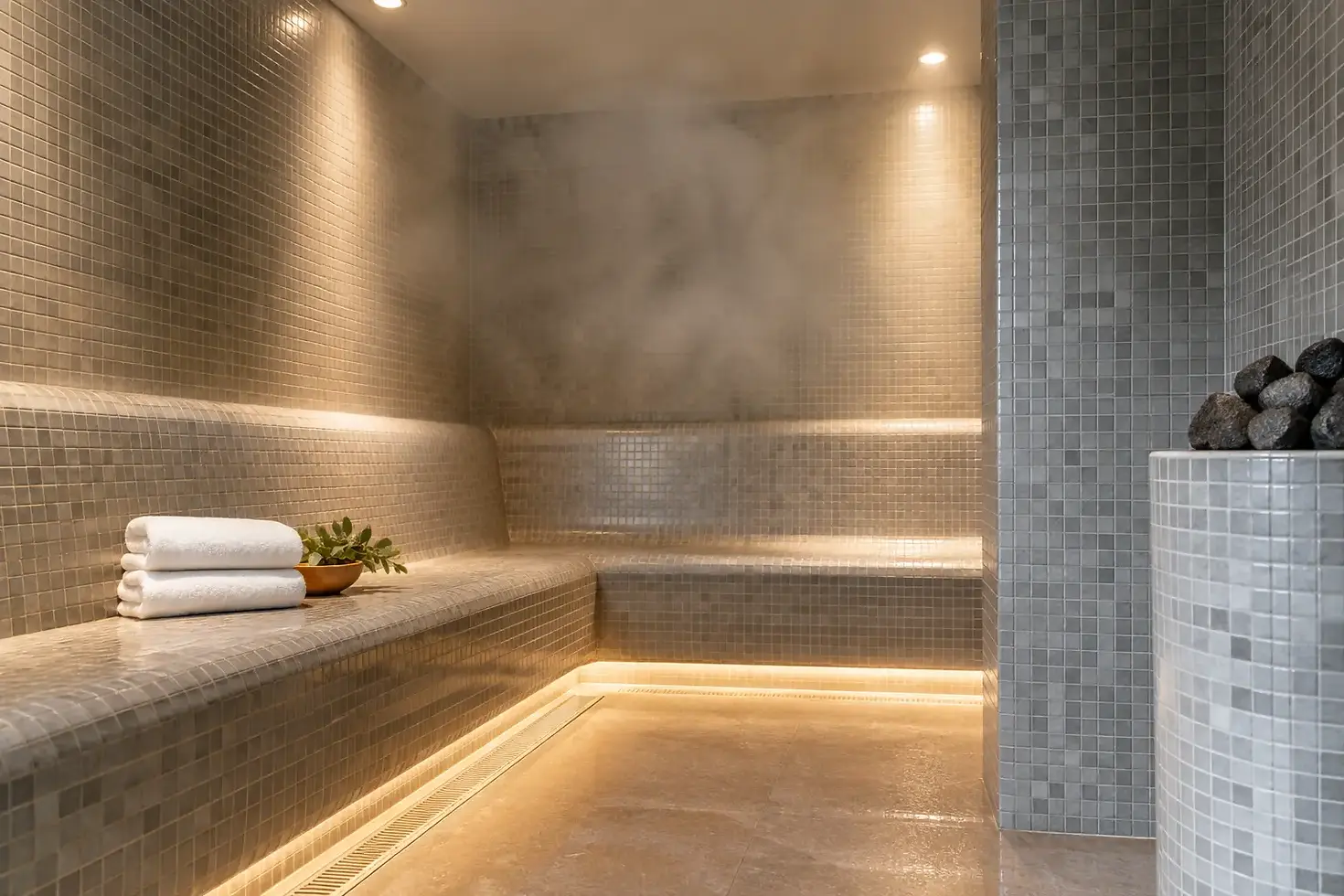
Best Tiles for Steam Rooms That Really Last
A steam room can look immaculate on handover and still fail prematurely if the tile finish has been chosen without regard for heat, vapour and constant saturation. The best tiles for steam rooms do more than complement the wider spa scheme. They must work with a properly specified waterproofing and vapour-control assembly, accommodate movement and provide safe footing when surfaces are wet.
For a private wellness room, hotel spa or leisure refurbishment, porcelain is usually the strongest starting point. Yet no single tile is right for every wall, bench, ceiling and floor. Format, surface finish, grout joint, substrate preparation and drainage all influence the result as much as the tile itself.
Why steam-room tiling demands more
A conventional shower receives intermittent water. A steam room repeatedly exposes every internal surface to high humidity, condensation and elevated temperatures. Vapour reaches walls, ceilings, seating, niches and service penetrations, then cools into water. That moisture has to be controlled behind the finish, not simply shed from its face.
This is why tile should never be treated as the waterproof layer. Even a tightly grouted porcelain installation allows a degree of moisture migration. The lasting performance comes from a compatible system: a sound substrate, a fully detailed waterproof membrane suitable for the environment, correctly sealed corners and penetrations, appropriate adhesive, grout and controlled falls to drainage.
On demanding spa projects, the detail at transitions is often where quality becomes visible. Mitred returns, recessed lighting, linear drains, curved benches and flush access panels all need to be planned before tiling begins. Retrofitting a solution once a large-format finish is on the wall is neither straightforward nor elegant.
Porcelain: the best all-round tile for steam rooms
Through-body or high-quality glazed porcelain is the first choice for most steam-room walls, ceilings, benches and floors. It has very low water absorption, excellent durability and a broad range of stone, concrete and marble-effect finishes. It also gives designers the freedom to carry one material from the steam room into a shower, changing area or wider bathroom suite.
Large-format porcelain creates a calm, architectural finish with fewer grout joints. A 1200 x 600mm marble-effect porcelain, for example, can make a private steam room feel more considered and expansive than a small modular layout. Carefully planned book-matching, narrow joints and crisp mitred external corners can produce the visual continuity associated with high-end hotel and residential work.
There are trade-offs. Large tiles require an exceptionally flat substrate and precise setting-out, particularly on benches and ceilings. They are less practical where walls curve tightly, where several planes meet, or where a floor needs pronounced falls towards a drain. A large-format floor tile may also leave too little grout-line texture for assured barefoot grip. In those areas, a smaller matching porcelain format or mosaic is often the better technical decision.
For floors, select a porcelain surface designed for wet barefoot traffic. A beautifully polished tile may be appropriate on a feature wall but is rarely sensible underfoot in a steam room. Slip resistance should be assessed alongside the tile profile, layout, drainage and intended users, rather than selected by a single rating alone.
Porcelain works particularly well for
Porcelain is especially effective where the brief calls for a seamless contemporary finish, low maintenance and long-term resilience. It suits steam-room shells, heated benches, feature walls and adjoining wet-room floors, provided each area is specified for its own movement, drainage and slip requirements.
Glass mosaics: ideal for curves, benches and detailed floors
Glass mosaics remain a strong choice for steam rooms, particularly in bespoke spa settings. Their small format follows curves, domed ceilings, sculpted seating and complex drainage falls far more easily than large tiles. They can also bring light into an enclosed room, whether through a soft pearlescent finish, rich colour or a finely blended tonal mix.
On floors, mosaic sheets offer frequent grout joints, which can improve underfoot grip when correctly grouted. They are well suited to circular drains, channel drains, shower-style falls and the rounded transitions often found in a luxury steam-room design.
The installation standard must be exact. Glass can reveal adhesive irregularities, and some products require a specific white adhesive to preserve colour and clarity. Mesh backing, sheet alignment and adhesive coverage all deserve scrutiny. Uneven sheets or poorly controlled joints are obvious once lighting reflects across the finished surface.
Glass also expands and contracts differently from many backgrounds and tile types. The adhesive and waterproofing assembly must therefore be compatible with the selected mosaic, while movement joints must be designed into the room rather than treated as an afterthought. A good-looking sample is not a substitute for checking the manufacturer’s requirements for use in a high-heat, high-moisture environment.
Natural stone: luxurious, but more demanding
Natural stone can give a steam room exceptional character. Honed marble, limestone and certain granites create a depth and individuality that even the best porcelain reproductions cannot fully replicate. In heritage properties and high-specification residences, that natural variation may be central to the design intent.
However, stone is not automatically one of the best tiles for steam rooms simply because it is premium. Many stones are porous, sensitive to acids and more demanding to maintain. Some can darken, stain or show mineral change when exposed to moisture over time. Polished marble can also be unsuitable for a wet floor.
If stone is specified, selection should be made on proven suitability rather than appearance alone. The room needs a carefully engineered waterproofing system, suitable adhesive, appropriate sealing regime and a client who understands the maintenance commitment. Honed stone on walls or benches can be a compelling choice; on floors, a textured or mosaic-format stone may offer better grip, but it will still require more attention than porcelain.
For projects that want the visual language of Calacatta, travertine or dark-veined marble with less ongoing risk, marble-effect porcelain is often the more practical route. The finished room can retain a refined, monolithic appearance while gaining easier cleaning and greater resistance to daily spa use.
Tile size should follow the surface
Steam rooms are rarely made from four simple walls. They include ceilings, benches, returns, niches, door reveals and drains. Selecting one tile size for every plane may look disciplined on a mood board, but it can create unnecessary compromises during installation.
A considered scheme may use large porcelain slabs or tiles on principal walls, a smaller cut format on benches and a matching mosaic on the floor. This keeps the design coherent while allowing proper falls and cleaner detailing. On a ceiling, smaller tiles can be easier to handle safely and may better accommodate any movement or irregularity in the substrate.
Avoid forcing very large tiles around tight external corners or into narrow recesses. Narrow slivers, poorly positioned cuts and awkward joints quickly dilute a premium finish. The strongest layouts are resolved before installation, with centre lines, tile orientation, lighting positions and fittings coordinated as part of the setting-out process.
Grout, adhesive and waterproofing are part of the finish
A steam-room specification should be approached as one compatible assembly, not a collection of individual products. Adhesive must suit the tile type, background and thermal conditions. Grout should resist staining and be appropriate for the cleaning regime, while flexible sealant is required at movement joints and changes of plane.
Epoxy grout is often considered for commercial spas and heavily used steam rooms because it offers excellent resistance to moisture, chemicals and staining. It is not always the automatic answer. It costs more, is less forgiving to install and requires disciplined cleaning during application. A high-performance cementitious grout may be suitable in some private settings, provided the wider system is correctly specified.
The waterproofing layer is the critical hidden element. It must continue behind every tiled surface and be fully sealed at corners, junctions, pipe penetrations, lighting details and drainage connections. Benches, niches and thresholds need the same attention as open walls. A beautifully mitred porcelain edge cannot compensate for a poorly detailed penetration behind it.
Do not overlook drainage and maintenance
All condensate and cleaning water must have a route to drain. Floors need purposeful falls, with tile format chosen to follow them without lipping or ponding. A linear drain can support a clean, contemporary layout, while a point drain may suit a mosaic floor more naturally. The drain detail, grate finish and surrounding cuts should be resolved early, not selected when the floor is already underway.
Maintenance should also influence material choice. Pale textured porcelain and heavily profiled mosaics can be safe underfoot, but they may hold soap residue if cleaning is inconsistent. Dark grout can disguise staining yet make mineral deposits more visible. The right balance depends on the operating standard of the property, whether it is a privately used retreat or a busy hotel facility.
A steam room deserves the same level of technical planning as any other moisture-intensive construction. Choose the tile for the surface it will serve, then invest equal care in the waterproofing, setting-out, drainage and finishing details behind it. That is how a luxurious room remains convincing long after the first cloud of steam has cleared.


Comments